
Solar battery storage Homes · Businesses · Community sites in Africa
Solar battery storage for homes, businesses and communities
The lights stay on when the grid does not. TenaPower helps you plan solar-charged battery storage around essential loads, backup hours and your project location.
- Sized around your actual loads
- Modular storage options
- Destination-specific guidance

A clearer route to reliable backup
From your site to a system quote
Follow four practical steps to plan a home solar battery system, business backup or community energy storage project.
- 01
Understand your use case
Start with the site
Explore guidance for homes, businesses, clinics and community sites, including destination-specific planning.
Explore applications - 02
Choose a system
Compare solar kits
Review published battery and inverter configurations, then shortlist options for your essential loads.
Compare systems - 03
Calculate your loads
Estimate backup needs
Enter appliances, usage hours and outage duration to prepare an initial storage and inverter estimate.
Use the calculator - 04
Talk through the project
Request a quote
Share your location, appliance list and preferred backup time so the final configuration can be reviewed.
Discuss your project
The cost of an outage
The generator was already paid for. It just costs more every week.
A solar-charged battery can cover selected evening loads without running a generator. Start with the appliances you need and the hours you need them.
Put your own numbers in the calculatorIllustrative 5 kVA generator estimate
| Evening outage | Fuel / month | Battery planning range |
|---|---|---|
| 2 hours nightly | ≈ 19 L | ≈ 3 kWh |
| 5 hours nightly | ≈ 47 L | ≈ 6–10 kWh |
| Overnight, nightly | ≈ 70 L | ≈ 15 kWh |
Illustrative arithmetic from the archived site, based on a typical 5 kVA set—not a quote or guarantee. Actual fuel burn varies by generator and load; battery sizing depends on your appliances and site conditions.
Solar kits
Pick a system for your site
Compare published kits, then confirm the final configuration against your loads and location.

Essentials 3.6
Apartment or small home — lights, fridge, TV, router, fans.
3.6 kW · 5.12 kWhView details ↗
Home 5 / 10
Family home — fridge, freezer, multiple rooms, TV, pump.
5 kW · 10.24 kWhView details ↗
Power 8 / 16
Large home — air conditioning, water pump, power tools.
8 kW · 15.36 kWhView details ↗
Community 15 / 30
Clinic, school, shop or small micro-grid.
15 kW · 30.72 kWhView details ↗The hardware
Three parts of one energy system
Explore the components that store, convert and collect energy.

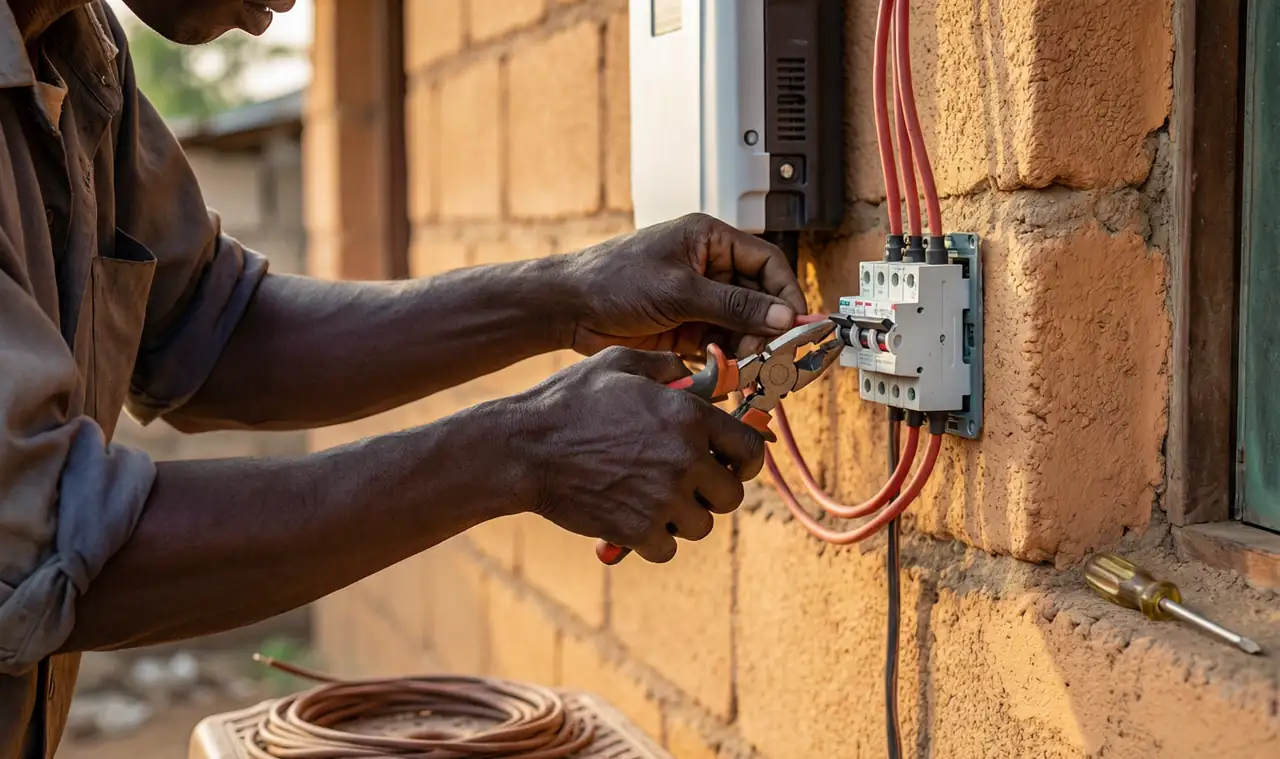
Designed as a complete system
Reliable power depends on more than the battery.
A good design matches your loads, equipment, protection and local installation requirements.
- Start with essential loadsIdentify what must stay on and for how long.
- Plan the system togetherConfirm inverter, storage and solar around your site.
- Check local requirementsHave a qualified installer confirm wiring, protection and applicable codes.
Where we work
Different grids, different paperwork
Browse destination guidance and confirm current requirements for your exact shipment.
Nigeria
Frequent grid collapse and expensive diesel make self-generation the norm. Reliable home storage pays for itself against generator fuel.
Read guide ↗Market guideCameroon
Mixed grid quality between cities and the hinterland. A growing middle class wants uninterrupted power for homes and small businesses.
Read guide ↗Market guideDR Congo
Kinshasa and provincial cities face chronic outages. Mining towns and clinics need dependable power where the grid is absent.
Read guide ↗Market guideSénégal
Dakar's SENELEC grid is improving but outages remain. Rural electrification drives demand for solar home systems.
Read guide ↗Your next step
Send your load list. Get a specification back.
Share your location, appliances and backup hours. We will help confirm a suitable configuration and the next steps.